Fall 2026

November 1: Groups Guide

About This Guide

The online groups guide is designed as a teaching series companion to foster discussion, study, and prayer, especially in a group setting.

Join a weekly group for a meaningful way to connect to our community.
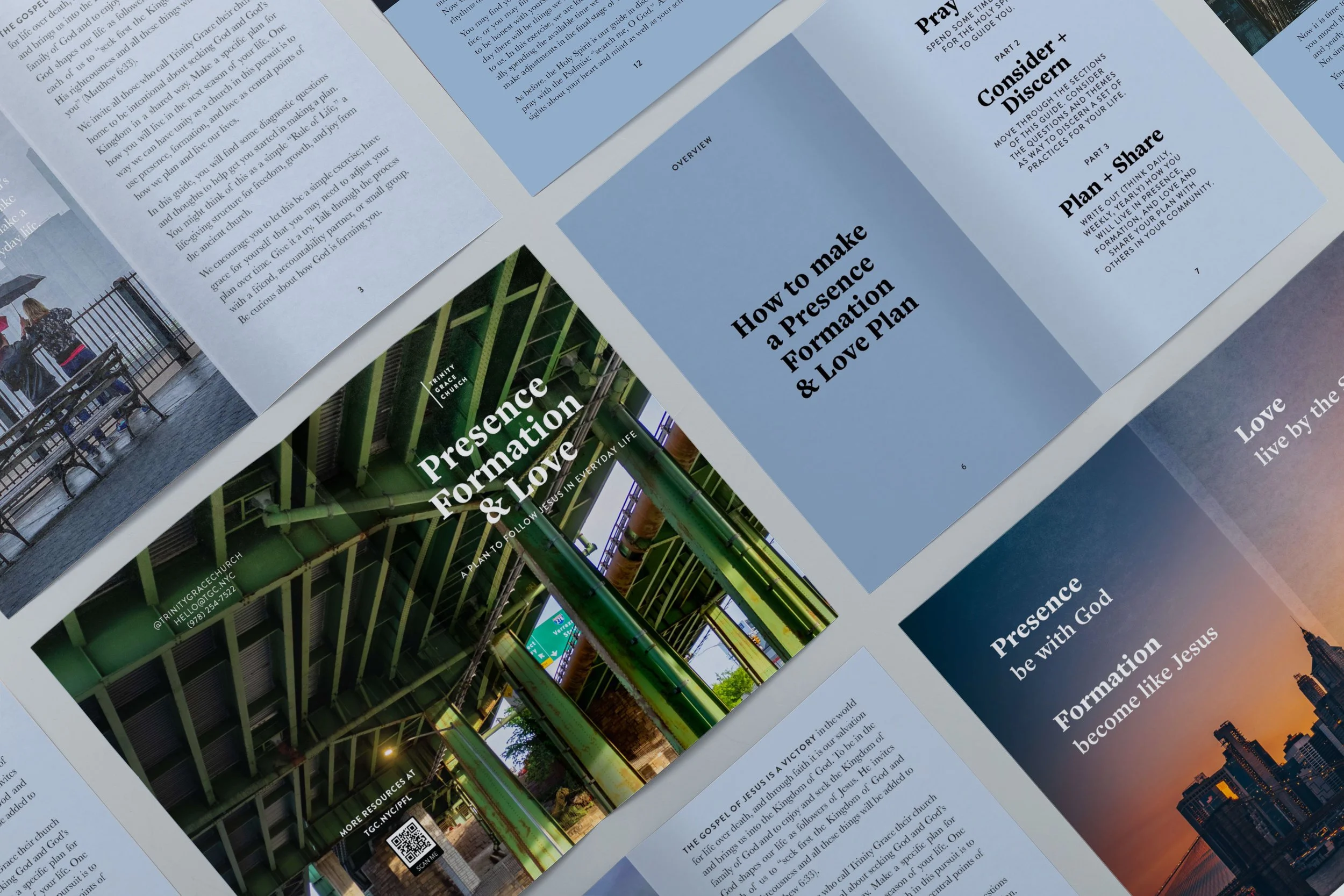
pdf download

Download this PDF to help you make a plan to follow Jesus in your everyday life, including diagnostic questions to help get you started.

Pickup a print version at our weekly in-person Sunday gatherings.

more Resources

Explore a curated online collection of recommended practices and resources to pursue presence, formation, and love in your life.

Questions about the series or looking for a way to get involved? Contact us.


Love

Teaching Text: 1 Corinthians 11:23–33 

For I received from the Lord what I also passed on to you: The Lord Jesus, on the night he was betrayed, took bread, and when he had given thanks, he broke it and said, “This is my body, which is for you; do this in remembrance of me.” In the same way, after supper he took the cup, saying, “This cup is the new covenant in my blood; do this, whenever you drink it, in remembrance of me.”For whenever you eat this bread and drink this cup, you proclaim the Lord’s death until he comes.

So then, whoever eats the bread or drinks the cup of the Lord in an unworthy manner will be guilty of sinning against the body and blood of the Lord. Everyone ought to examine themselves before they eat of the bread and drink from the cup. For those who eat and drink without discerning the body of Christ eat and drink judgment on themselves. That is why many among you are weak and sick, and a number of you have fallen asleep. But if we were more discerning with regard to ourselves, we would not come under such judgment. Nevertheless, when we are judged in this way by the Lord, we are being disciplined so that we will not be finally condemned with the world.

So then, my brothers and sisters, when you gather to eat, you should all eat together.


Themes

Consider these themes and ask your group what else they see in the passage:

  • A Living Communion

  • The Calling to Become Communion


Formation 

Thoughts and notes you can use for discussion:

Sermon Summary

  • “The pain lasts a few days. The sermon illustrations last a lifetime.”

    • Three NYC Marathons. Biggest lesson between race one and race three? Nutrition.

    • Early on: eat when hungry. Later: eat on a schedule. Not because I felt hungry, but because my body was spending, and I had to put back in. Didn’t hit the wall nearly as hard.

  • We come to the table every week. Not because we’re physically hungry. We come to be formed by this meal.

    • Nourished by the love of God

    • Aware of the cost of his extravagant love

    • Reminded that He’s not just a God in a past story. He promised to return. His resurrection becomes ours.

    • Aware of each other, because we’re becoming a Eucharistic community

  • What we have received, we pass on. Love. Grace. Forgiveness. Attentiveness. Mercy.

  • Corinth: a city church in trouble.

    • Full of faith. Struggling to live as Jesus people. Unity in diversity? They kept sliding back into the world’s status rankings. At the meal itself.

  • God is insistent on this. Remember Acts 5. Radical generosity, and a couple lies to get the credit. The consequences are devastating. Why so severe? God is protecting the infant church from power scheming, status anxiety, manipulation. God is insistent to keep the good news, good news.

  • So Paul writes with a stern correction. And he opens with:

    “For I received from the Lord what I also passed on to you.”

  • Two things:

    • The Kingdom moves along relational lines. Passing on what we’ve received. God gets us involved.

    • This predates our Gospels. Paul wasn’t quoting the four accounts. He was passing on what he’d received: from Jesus, the Spirit, those in the room.

  • What did Jesus come to do? Announce the Kingdom. Reveal it. Invite us in.

    • Describing it. The Good Samaritan.

    • Demonstrating it. Feeding, forgiving, freeing. Washing feet.

    • Inviting us in. Through His life, death, and resurrection.

  • Describing: Luke 10.

    • An expert in the law: “What must I do to inherit eternal life?” Jesus answers with a question. The man gives the right answer: love God, love neighbor. Then wants to justify himself: “Who is my neighbor?”

    • Jesus tells a story. Brutal mugging. Jerusalem to Jericho: 17 miles, a 3,500 ft descent, 300 ft drops with no shoulder. Thieves everywhere. Likely based on a real event.

    • The man is stripped, beaten, unconscious. Unrecognizable. No clothes, no speech, no identity.

    • A priest passes by. A Levite passes by. Hearers would know why. Touch a corpse, unclean for a week. Skip the week and enter the temple, capital offense. Priest: wealthy, riding. Levite: poor, walking, and his supervisor just rode past.

    • And everyone knew the formula. Priest, Levite, and next comes… the layman.

    • He shocks them. A Samaritan. The despised enemy is the hero.

    • And the cost:

      • Alone in dangerous territory

      • Bandits still around

      • Exposed to suspicion. Why wouldn’t they think he did it?

    • HE SAW HIM. HE HAD COMPASSION. HE WENT TO HIM. HE USED HIS OWN OIL AND WINE. HE WALKED THE DANGEROUS ROAD. HE BROUGHT HIM TO SAFETY. HE PAID THE COST.

    • Jesus makes your neighbor include your enemy. The Kingdom of God has sacrificial love for enemies at its heart. And Jesus has done that for us. When we couldn’t help ourselves, He gave His life.

  • Demonstrating: the Upper Room.

    • Same Jesus. Same night He’s betrayed. He washes their feet. Humility in action. The least is the greatest. Go and do the same.

    • The Good Samaritan Jesus. The foot-washing Jesus. The Cross Jesus.

    • Now He has a community, led by His Spirit… hoarding food, ignoring the poor, getting drunk, sorting by status.

    • Paul says: this cannot be.

    • Does that mean you can’t come unless every sin is confessed? No. Examine your heart before God, yes. But you can’t earn this. It’s a gift of life won by sacrificial love. The problem in Corinth was ego. Pride. Disdain for the other. Or worse, so absorbed in your own comfort you forget everyone else.

  • What is this meal?

    • The body and blood of Jesus.

    • A proclamation of His death. Mercy and victory.

    • A promise of his return. The resurrection life, fully known.

  • It calls us to perceive the body. Aware of each other. A new family. A new way of seeing.

  • When we eat this meal, we become this meal. Christ broken and poured out for us. We, broken and poured out for each other. For our neighbor. Even the neighbor who was our enemy.

  • Urgent, because the distortion wounds. This is why church hurt, hurts so deeply. But communion is too important to give up on because of bad examples.

  • Be nourished. Free gift. The mercy and victory of the Cross. Be aware of the body. Saved as a family. Pass on what you’ve received. Freely. Christ is our supply.

Direct Quotes

  • “We eat this meal and we become this meal.”

    — The Preacher

  • “The eucharist [is] not simply an occasion for Christian devotion and fellowship, but a powerful statement to the world at large, and perhaps particularly to the ‘rulers and authorities’ who put Jesus on the cross, not realizing that this would bring about their own downfall. It is the announcement of Jesus’ death; and through Jesus’ death the powers are defeated, and people who were enslaved to them are rescued.”

    — N.T. Wright

  • “When the meal is celebrated the Lord himself is there, not simply absent, away in the past, or longed for at his coming in the future, but present through this ‘memorial.’ The eucharist is the moment at which the past event comes forward to live again in the present, and the future moment of the Lord’s return comes backwards in time to challenge us in the present.”

    — N.T. Wright


Three Questions for Personal Application

  1. What am I coming to the table to receive? Not because you’re hungry, but because you need to be formed. What would it look like to come this week knowing you can’t earn it, and simply be nourished by His love? Where do you need to put back in what life has been spending?

  2. Whom am I ignoring, or ranking below me? Pride and disdain can be loud. Absorption in our own comfort is quieter. Ask Jesus to show you the person, or the kind of person, you’ve passed on the other side of the road. What would it cost to stop?

  3. What have I received that I’m meant to pass on? Love, grace, forgiveness, mercy. All freely given to you. Who in your life needs to receive it from you this week? Trust that Christ is your supply, and you don’t have to hold anything back.


“For whenever you eat this bread and drink this cup, you proclaim the Lord’s death until he comes.”

— 1 Corinthians 11:26

October 25: Groups Guide

About This Guide

The online groups guide is designed as a teaching series companion to foster discussion, study, and prayer, especially in a group setting.

Join a weekly group for a meaningful way to connect to our community.

pdf download

Download this PDF to help you make a plan to follow Jesus in your everyday life, including diagnostic questions to help get you started.

Pickup a print version at our weekly in-person Sunday gatherings.

more Resources

Explore a curated online collection of recommended practices and resources to pursue presence, formation, and love in your life.

Questions about the series or looking for a way to get involved? Contact us.


Love

Teaching Text: John 14:14–18

You may ask me for anything in my name, and I will do it.

“If you love me, keep my commands. And I will ask the Father, and he will give you another advocate to help you and be with you forever— the Spirit of truth. The world cannot accept him, because it neither sees him nor knows him. But you know him, for he lives with you and will be in you. I will not leave you as orphans; I will come to you.

2 Corinthians 3:17–18

Now the Lord is the Spirit, and where the Spirit of the Lord is, there is freedom. And we all, who with unveiled faces contemplate the Lord’s glory, are being transformed into his imagewith ever-increasing glory, which comes from the Lord, who is the Spirit.


Themes

Consider these themes and ask your group what else they see in the passage:

  • A Living Communion

  • The Invitation to Experience Communion – Friendship with God and Each Other


Formation 

Thoughts and notes you can use for discussion:

Sermon Summary

  • “Is the spiritual world real?”

  • Not just real. God shapes and defines reality. That’s why we’re here.

  • All fall we’re looking at: a living communion. Friendship with the risen Jesus as the lifeblood of our faith. Fr. Charbel Abernethy calls it:

    “The terrifying and beautiful possibility of becoming wholly alive in God.”

  • The problem? For most of us, it gets compartmentalized. One box in a busy life. Pressure, distraction, busyness. Not outright rebellion. Just life.

  • But what we look at matters. We become what we behold.

  • The resistance is real. Scripture names three kinds: flesh, world, devil.

    • Personal. Our inner habits. Living as our own gods. Meeting our deepest needs from our own resources. Called sin.

    • Systemic. Evil ingrained in culture until we just call it life. Radical individualism. Economies built on exploitation. Porn out-earning medicine. More on bombs than education.

    • Spiritual. Real forces. Deception, temptation, accusation. The see-saw: “It’s no big deal, you deserve it, who will know” … then “What kind of person are you? You’ll never change.”

  • It doesn’t look the same everywhere. Friends on the Tibetan frontier, in the slums of India after the tsunami: spiritual attack was a given. Moving back from Western China, the contrast was stark. We in the developed world just don’t expect it.

  • The cost of not living in communion is real, too. Growing up I was warned about shows, music, movies. Didn’t take it seriously. Then: massive anxiety attacks in college. Years of rethinking. Gentle with myself, but I made changes. My mentor took me to Philippians 4:8 — whatever is true, noble, pure, lovely, excellent, think on these things. More worship music. More care in what I watched and read. And it helped. Not legalism. Like breathing fresh air.

  • The Gospel in two texts.

    • First move: Jesus shows us what God is like. Michael Ramsey: “God is Christlike, and in him is no un-Christlikeness at all.”

    • Second move: Jesus is leaving, and the disciples are shaken. He says: “I will not leave you as orphans.” Then the shocker: “It is for your good that I am going away.” Good?! Yes. The Spirit comes. The Spirit always lifts up Jesus.

      • “Where the Spirit of the Lord is, there is freedom. And we all, with unveiled faces, contemplate the Lord’s glory, are being transformed into his image.”

  • We look at Jesus. By the Spirit, we are transformed.

  • Attention shapes life. Prayer is attention on God. Can’t focus? Start where you are. Pray how you can, not how you can’t.

  • This week: “He rescued me because he delighted in me” (Ps 18:19). Do you think of God that way?

  • Three implications:

    • Look to Jesus to know what God is like, especially when you forget. When the enemy whispers “Is God really like that?” When delay feels like cruelty. When you’re defined by your failure. The Son is the exact representation of God (Heb 1:3). The Cross: love crucified. “It is finished.” Not “it’s nearly done. Good luck. Be better.” The veil is torn. Look with unveiled faces.

    • Worship is lifting our gaze. Gratitude leads to worship. Worship leads to gratitude. Body and soul together. Romans 12: offer your bodies as a living sacrifice; be transformed by the renewing of your mind, then you can know and approve God’s will.

    • Prayer is the gift of attention, yours and God’s. Where does your mind go most? Can it come back to God each day? You can reset a day at any moment. The most important opportunity of every day: communion with God.

  • Can’t see him? Ask. Look in the Gospels. Have a friend pray for you. Ask for a filling of the Holy Spirit.

Direct Quotes

  • “Modern civilization, at least in much of the developed world, increasingly wages war upon the inner life itself. Attention fragments continually. Silence disappears. The imagination becomes saturated with images. The nervous system remains overstimulated. The person exists in a state of continual distraction and reaction. This warfare often appears invisible because it has become normalized culturally.”

    — Fr. Charbel Abernethy

  • “[Fallen humanity] exists in a state of dispersion. The mind scatters outwardly through the passions. Attention fragments continually. Desire becomes unstable. The heart loses inward unity. Modern civilization intensifies this condition dramatically because technology now externalizes distraction on a civilizational scale.”

    — Fr. Charbel Abernethy

  • “God is most glorified in us when we are most satisfied in Him.”

    — John Piper, Desiring God (1986)

  • “Pray with your body at certain times each day, and your soul eventually catches up.”

    — Tish Harrison Warren

  • “Act your gratitude; pantomime your thanks; you will become that which you do.”

    — Eugene Peterson


Three Questions for Personal Application

  1. Where does my attention go most often? Think about the last 24 hours: what filled your mind, your eyes, your ears? Ask Jesus to show you what’s been shaping you, without shame, and what one small change might feel like fresh air.

  2. What do I really believe God is like? When you’re tired, behind, or ashamed, whose voice do you hear: Christ’s, or the see-saw of rationalization and shame? Bring the picture in your head to Jesus and ask him to show you the Father as he truly is.

  3. How can I lift my gaze today? Worship might be gratitude, a posture, a prayer with your body at a set time. What is one simple, doable way to come back to God when the day scatters you? Pray how you can, not how you can’t.


“And we all, who with unveiled faces contemplate the Lord’s glory, are being transformed into his image with ever-increasing glory, which comes from the Lord, who is the Spirit.”

— 2 Corinthians 3:18


October 18: Groups Guide

About This Guide

The online groups guide is designed as a teaching series companion to foster discussion, study, and prayer, especially in a group setting.

Join a weekly group for a meaningful way to connect to our community.

pdf download

Download this PDF to help you make a plan to follow Jesus in your everyday life, including diagnostic questions to help get you started.

Pickup a print version at our weekly in-person Sunday gatherings.

more Resources

Explore a curated online collection of recommended practices and resources to pursue presence, formation, and love in your life.

Questions about the series or looking for a way to get involved? Contact us.


Love

Teaching Text: John 3: 12–17

I have spoken to you of earthly things and you do not believe; how then will you believe if I speak of heavenly things? No one has ever gone into heaven except the one who came from heaven—the Son of Man. Just as Moses lifted up the snake in the wilderness, so the Son of Man must be lifted up, that everyone who believes may have eternal life in him.”

For God so loved the world that he gave his one and only Son, that whoever believes in him shall not perish but have eternal life. For God did not send his Son into the world to condemn the world, but to save the world through him.

1 Corinthians 2: 1–2

And so it was with me, brothers and sisters. When I came to you, I did not come with eloquence or human wisdom as I proclaimed to you the testimony about God. For I resolved to know nothing while I was with you except Jesus Christ and him crucified.


Themes

Consider these themes and ask your group what else they see in the passage:

  • A Living Communion

  • The Love That Is God


Formation 

Thoughts and notes you can use for discussion:

Sermon Summary

  • I like to imagine Nicodemus sneaking his way towards where he’d heard Jesus was staying. Scanning the street nervously. Did he try to disguise himself a little?

  • Many of us know that feeling. Intrigued by Jesus. Heard some things. Maybe had some experiences of God. But not exactly hoping someone from work sees us walking in.

  • And out of this nervous, curious conversation at night comes the most famous verse in the New Testament: John 3:16. Followed by John 3:17: God did not send His Son to condemn the world, but to save it.

  • What needs saving in the world? And how does God go about it?

  • Nicodemus asks: Who are you? Jesus goes a level under the question: No one can see the kingdom of God unless they are born again.

  • You are born in the natural. Then you are born of the Spirit.

  • The teaching text gives us three movements:

    • The Son of Man must be lifted up.

    • God so loved the world that he gave his one and only Son.

    • This gift is for salvation and eternal life.

  • We were created for communion with God. What’s broken is that we don’t live that way. We live only by human resources (water birth), not alive in God. A Living Communion is what the Kingdom of God looks like in a life. And the climactic moment of that Kingdom is Jesus lifted up: the love that is God revealed as crucified love.

  • “Jesus died for my sins.” True. Essential. But often heard as merely transactional. Slate wiped clean, now go try harder. Morally striving. Modifying behaviour. Grateful, maybe guilty. But living from relational distance.

  • Jesus says it’s about being born in an entirely new way. A way that restores communion.

  • Forgiveness without ongoing communion? We know from experience something’s missing.

  • Ways the Church has seen the Cross:

    • Substitution (Yom Kippur): he who knew no sin became sin for us, so we might become the righteousness of God.

    • Ransom (Exodus): brought out from the hold of sin, death and evil.

    • Recapitulation: Jesus became what we are so we could become what he is.

    • Christus Victor: Christ’s victory over sin and death, which we share through union with him.

    • Representation (Second Adam): Jesus identified with us “all the way down.”

    • Supreme Expression of God’s Love: a love that generates regenerative love in us, so we take up the cross and serve.

  • Don’t pick one. Scripture holds them all (see Scot McKnight, A Community Called Atonement). The redemption we need, and the world needs, is thorough and complete.

  • Colossians 2 puts several together. The Cross:

    • Forgives us

    • Cancels our legal indebtedness

    • Removes condemnation

    • Publicly disarms the powers and authorities

    • Wins a victory that faith gives us a share in

  • Much American Christianity holds a mainly courtroom vision. God lets us off the hook, and we go our way grateful. But we don’t walk in the victory. We don’t live in restored communion. We barely believe how ongoingly loved we are.

  • Sin is not only transgression. It’s an illness of the soul. And the gospel is for healing.

  • So what does this mean for your salvation?

  • Forgiven. Free. Victorious. Known by name. Sharing a future with God. Born of the Spirit. Able to resist what once held you captive.

  • And being healed. Slowly but surely. Old wounds. False identities. Crushed by shame. The Cross addresses these.

  • Jesus says: come and die, and live.

  • For you. For me. For the whole world. At every level.

  • And it shapes us as a community. We come to the Cross as a healing community. We go into the world in sacrificial love, laying our lives down to really receive them. For our neighbours. Dare I say, even our enemies.

  • The Cross is not just a legal argument, though it can be that. It’s an invitation into communion. To walk in the Garden, like the thief heard.

  • Broken and poured out? You’ll need the endless supply of the Holy Spirit. But friends, this is life to the full.

Direct Quotes

  • “The ‘kingdom of God’ is a way of talking about the restoration of creation through God’s will being done in this world in the same way that God’s will is accomplished in heaven; it is an image of how the darkness of this world could be lifted if people would turn away from—repent of—living solely for themselves and turn back to living for the God who is love. What Jesus calls the good news is his proclamation that this is beginning to come to pass, the kingdom is drawing near. It is drawing near in the words and actions of Jesus himself.”

    — Frederick Bauerschmidt

  • “The healing and transfiguration of the human person through communion with the living God.”

    — Fr. Charbe Abernethy

  • “Through the forgiveness of sins the gospel breaks through the compulsive acts of sinners which are the enemies of life, cutting sinners loose from sin, and creating the possibility of ‘conversion,’ a turn to life. Through the justification of sinners, the gospel brings men and women who are closed in upon themselves into the open love of God. Through rebirth from the Spirit, it brings people who have been subject to death into touch with the eternal source of life, setting them in the closer framework of the rebirth of human community and against the wider horizon of the rebirth of the cosmos.”

    — Jürgen Moltmann

  • “The kingdom of God, in short compass, is the society in which the will of God is established to transform all of life. The kingdom of God is more than what God is doing ‘within you’ and more than God’s personal ‘dynamic presence’; it is what God is doing in this world through the community of faith for the redemptive plans of God—including what God is doing in you and me. It transforms relationship with God, with self, with others, and with the world.”

    — Scot McKnight


Three Questions for Personal Application

  1. Am I living forgiven but distant?

    Have I treated the Cross as a transaction, a clean slate, and then gone back to striving on my own? Where do I feel relational distance from God, even though I believe I’m forgiven? What would it look like to come close instead of just trying harder?

  2. Do I believe I am ongoingly loved?

    Not loved once, at a moment in the past, but loved today, right now. Which old wound, false identity or shame still speaks louder than the Cross? Can I bring it to Jesus this week and let him begin to heal it, slowly but surely?

  3. Where is Jesus inviting me to die so that I can live?

    The life of communion is a poured-out life. Who is the neighbour, or even the enemy, God may be asking me to lay my life down for? And am I drawing on the Spirit’s endless supply, or running on my own resources?


October 11: Groups Guide

About This Guide

The online groups guide is designed as a teaching series companion to foster discussion, study, and prayer, especially in a group setting.

Join a weekly group for a meaningful way to connect to our community.

pdf download

Download this PDF to help you make a plan to follow Jesus in your everyday life, including diagnostic questions to help get you started.

Pickup a print version at our weekly in-person Sunday gatherings.

more Resources

Explore a curated online collection of recommended practices and resources to pursue presence, formation, and love in your life.

Questions about the series or looking for a way to get involved? Contact us.


Love

Teaching Text: John 17: 1–5

After Jesus said this, he looked toward heaven and prayed:

“Father, the hour has come. Glorify your Son, that your Son may glorify you. For you granted him authority over all people that he might give eternal life to all those you have given him. Now this is eternal life: that they know you, the only true God, and Jesus Christ, whom you have sent. I have brought you glory on earth by finishing the work you gave me to do. And now, Father, glorify me in your presence with the glory I had with you before the world began.


Themes

Consider these themes and ask your group what else they see in the passage:

  • A Living Communion

  • The Rich Welcome and Deep Belonging in the Heart of Christ


Formation 

Thoughts and notes you can use for discussion:

Sermon Summary

  • A wedding photo, twenty-two years old:

    There’s a shot across the room at our wedding reception where my dad and I are giving each other thumbs up. It could be nothing really. The simplest gesture… My dad is crying, which I had not seen him do for most of my life… My father would be dead in six months. Things were culminating. Things were changing forever. There was celebration. There were tears. There was a kind of grief at an era’s ending. And the picture shows a thumbs up.

  • A simple moment holding layers of story. That’s John 17.

  • Jesus goes to prayer, as His custom was. But this prayer gathers threads from across the ages. And it opens with: “Father, the hour has come.”

  • The meal is done. A betrayal is underway. Soldiers are coming. Agony, a false trial, a cross. All ahead.

  • But “the hour” means more than this one night. As far back as we have record, this hour has been on its way.

    • The Garden. God makes garments of skin and clothes ashamed, hiding people. Tender and brutal. Something dies. God covers them, and there is a cost.

    • Abraham. A farmer walks out of Ur into the dark desert, toward a nameless, unseen God. God will pass healing through relationship. Through promises kept.

    • Jacob. On the run. Wrestles God. Gets a new name.

    • Moses. A shepherd in hiding becomes a liberator. Slowly. Almost against his will. And still, a lamb is slain.

    • The Prophets. The nation can’t carry its vocation. God never gives up. The best kings and prophets keep speaking a secret: a Servant who will be a light to the nations. Pierced for our transgressions. By his wounds we are healed.

  • Hundreds of promises, all sketching the same face. All showing the fountain in the heart of God.

  • Then in John 17 the curtain is pulled back further. We hear the conversation in the heart of the Trinity.

  • Most of us piece God together in fragments. (Ask the sheep in The Sheep Detectives: a shepherd, a lamb, invisible, made of bread.) But is there a better place to learn God’s heart than listening in on the Son praying to the Father?

  • God’s heart is to share God’s eternal life with us.

  • Eternal life is to know God. Not just later. Right here, now.

  • Jesus is finishing the work that has been in God’s heart from forever past.

  • So what does that mean for us?

    • Bring this into the moments you question God’s care.

      Jesus asks for something he doesn’t get. Jesus experiences the Father turning away. How committed is God to healing the world? To healing your soul? This committed.

    • See the pattern for how God heals the world, and where we join in.

      Faithfulness. Sacrificial love. Integrity.

    • The commitment in the heart of God is our salvation. And it is our call to join in the renewal of all things.

  • Is God’s heart showing up in ours? Our time. Our money. Our energy. How we pray. How we live.

  • God keeps promises. God will finish what God started.

  • Not so life gets a little better. So we share in the life of God. In actual choices.

  • Pray. Communion.

Direct Quotes

  • I like to imagine Abraham, looking every bit the madman, staring out into the frightening void of the dark desert. Feeling a pull, a powerful tow toward a nameless, unseen God. Behind him, all the might of the city, the walls of the grain storehouses. From the towering pyramid shaped temple he can hear the drums, screams, and pagan chanting. In his gut, the doubt, the conflicting emotions, the fear that everything he has believed until now is wrong. The city represented safety, comfort, the known. In front of him, the desert representing death, darkness, mystery, and the unknown. Then the resolution, the determination, the trust, followed by the first step, away from the city, away from Ur. The first step of faith into the unknown, into the arms of God.

    — Mark Sayers

  • This ‘eternal life’, this life of the coming age, is not just something which people can have after their death. It isn’t simply that in some future state the world will go on for ever and ever and we shall be part of it. The point is, rather, that this new sort of life has come to birth in the world in and through Jesus. Once he has completed the final victory over death itself, all his followers, all who trust him and believe that he has truly come from the father, and has truly unveiled the father’s character and purpose—all of them can and will possess ‘eternal life’ right here and now.

    — N.T. Wright

  • The greatest issue facing the world today, with all its heartbreaking needs, is whether those who…are identified as “Christians” will become disciples—students, apprentices, practitioners—of Jesus Christ, steadily learning from him how to live the life of the Kingdom of the Heavens into every corner of human existence.

    — Dallas Willard

  • “So god is a big invisible lamb beaver made of bread?” “Yes, and they eat him on Sundays.” “Poor God.”

    — The Sheep Detectives


Three Questions for Personal Application

  1. Where am I questioning whether God really cares?

    Name the place where God has felt distant or silent. Then remember that Jesus prayed for a different cup and felt the Father turn away, and God’s commitment didn’t waver. Ask God to meet you there.

  2. Do I know God, or only facts about God?

    Jesus says eternal life is knowing the Father and the Son. Think about whether your faith is built on fragments, or on time spent in his presence. What would it look like to listen in on his heart this week?

  3. Is God’s heart visible in how I actually live?

    Look honestly at your calendar, your spending, your prayer life. Where are faithfulness, sacrificial love, and integrity already showing up? Where is God inviting you to join his work of renewal?


October 4: Groups Guide

About This Guide

The online groups guide is designed as a teaching series companion to foster discussion, study, and prayer, especially in a group setting.

Join a weekly group for a meaningful way to connect to our community.

pdf download

Download this PDF to help you make a plan to follow Jesus in your everyday life, including diagnostic questions to help get you started.

Pickup a print version at our weekly in-person Sunday gatherings.

more Resources

Explore a curated online collection of recommended practices and resources to pursue presence, formation, and love in your life.

Questions about the series or looking for a way to get involved? Contact us.


Love

Teaching Text: Genesis 1:1-4

In the beginning God created the heavens and the earth. Now the earth was formless and empty,darkness was over the surface of the deep, and the Spirit of God was hovering over the waters.

And God said, “Let there be light,” and there was light. God saw that the light was good, and he separated the light from the darkness.

Matthew 3:16-17

As soon as Jesus was baptized, he went up out of the water. At that moment heaven was opened,and he saw the Spirit of God descending like a dove and alighting on him. And a voice from heavensaid, “This is my Son, whom I love; with him I am well pleased.”


Themes

Consider these themes and ask your group what else they see in the passage:

  • A Living Communion

  • The Communion at the Heart of God


Formation 

Thoughts and notes you can use for discussion:

Sermon Summary

  • This year they made a movie of the Odyssey. Big posters. Jason Bourne as Odysseus. But the line that matters is buried in the middle. Odysseus goes down to the Underworld, and Achilles, the greatest Greek hero, tells him it wasn’t worth it. Dr. Martin Shaw sees Christ arriving right there:

    • I’ve long held the strange idea that the arrival of Christ begins in the middle of Homer’s Odyssey. When Odysseus visits the Underworld and Achilles tells him the following, the game is up for the old order: “Sooner be a slave to a poor man than King of the Underworld.” With these words, from the greatest of Greek heroes, the world turns… A shield is hurled on a stone floor. A fresh consciousness. Yeshua, the God-Man is coming. The last shall be first.

      — Dr. Martin Shaw

  • Glory through heroic violence, chased all the way to the end. The telos had to change. The Odyssey is saying something about what breaks the world.

  • Two scenes, creation and new creation, and in both we see God in conversation with God. What Dallas Willard called the Divine Conspiracy.

    • The Trinity at work in creation.

      • Bereshit bara Elohim. Elohim: plural, used as singular. A Creator (bara). A Spirit hovering over the deep like a fluttering bird. A Word speaking light into being.

      • Creator. Spirit. Word.

      • Order out of chaos. Tohu va-vohu, the formless void, separated and filled. Beauty. Majesty. Swarming, teeming abundance. Then: “Let us make humans in our likeness.”

      • The Trinity is creating not as a display of power or to make up for some lack, but in overflowing abundance.

      • Every other ancient Near Eastern story starts with gods at war. Not this one. No other conceived deity is like this.

      • But we forget. Give us long enough and we make God in our own image.

    • The Trinity at work in redemption.

      • The world breaks. And God sets out to repair it, not in spite of relationship, but through it. Pagan farmers get invitations. Sons become family, become a nation, become people of covenant. Isaiah speaks of one to come. Homer may even hint.

      • Then Yeshua shows up and breaks the categories again. Humble birth. A craftsman for thirty years. Baptized by His more famous cousin.

      • Heaven opens. The Father speaks. The Spirit descends like a bird, again. The Son comes up out of the water.

      • The Trinity, all the way at work in repair. In salvation. In healing.

      • Not arms crossed. Not petty and too busy. In the river. Under the water. Praying. Resisting the old liar from the Garden. Calling apprentices. Opening the way home for anyone who wants it

  • We put scarcity in God. What if God isn’t too busy at all? It’s us that’s too busy, chasing kleos, imperishable glory, our own way.

  • What if God abounds in so much love and attentiveness you could never reach the end of it?

  • Shaw again. Years after a Lakota medicine man told him not to give up on Jesus, he spent 101 days offering stories in the forest as prayer. Last night, he looked up. A light fell from the sky, aimed straight at him. He went home sensing an invitation. Pursued. A month later, baptized in the river.

  • If you’re looking for a world that isn’t a little strange, you’ve come to the wrong place. Or maybe you’ve mixed up what’s strange and what isn’t.

  • You are made for communion with God. Not just church attendance. Not just a respectable life, good vacations, enough for retirement. Full communion with a God who loves you all the way.

  • I am broken and poured out for you.

  • May you be in this Triune Love. And may you learn to be broken and poured out too.

  • Pray. Communion.

Direct Quotes

  • “What comes into our mind when we think about God is the most important thing about us.”

    — C.S. Lewis (as cited)

  • “This is of particular significance in light of the fact that one of the inherent characteristics of all other ancient Near Eastern cosmologies is the internecine strife of the gods. Polytheistic accounts of creation always begin with the predominance of the divinized powers of nature and then describe in detail a titanic struggle between the opposing forces. They inevitably regard the achievement of world order as the outgrowth of an overwhelming exhibition of power on the part of one god who then manages to impose his will upon all other gods.”

    — Nahum M. Sarna

  • “Jesus. We knew he was coming. We’d heard his words. Long before white folks told us. He was in Turtle Island too. Don’t give up on him now, he hasn’t given up on you.”

    — Wallace Black Elk

  • “This is not what you expect to hear from a shaman. This is the last thing I would have wanted to hear. Having abandoned Christianity with full vigor at seventeen, coming from a house of preachers and signs and wonders, well, this was a wonder too much. I didn’t want to see the slim finger of the medicine man pointing to what I’d been running from.”

    — Dr. Martin Shaw

  • “Then I did something I never do. I looked up. Past the trees into the sky. And it was then that I saw it… It was painfully beautiful, seemingly impossible. An arrow falling from the sky. I just couldn’t move… I sat up for the rest of the night, agape, ecstatic. I wasn’t frightened. I even danced.”

    — Dr. Martin Shaw


Three Questions for Personal Application

  1. What comes into my mind when I think about God, and have I made Him in my own image?

    Notice the picture of God you actually carry day to day. Is He distant, annoyed, too busy for you? Hold that up against the delighting, abundant God of Genesis 1 and ask Him to show you who He really is.

  2. Where am I still chasing my own version of imperishable glory?

    Achilles got to the end and found it empty. Name the achievement, image, or security you’re quietly building your life around. Ask what it would look like to trade it for communion.

  3. Do I believe God has enough love and attention for me, right now?

    Maybe you’ve been saving God for when you’ve tried everything else. Sit with the Father’s words over the Son, “whom I love; with him I am well pleased,” and let yourself be invited home.