About This Guide
The online groups guide is designed as a teaching series companion to foster discussion, study, and prayer, especially in a group setting.
Join a weekly group for a meaningful way to connect to our community.
pdf download
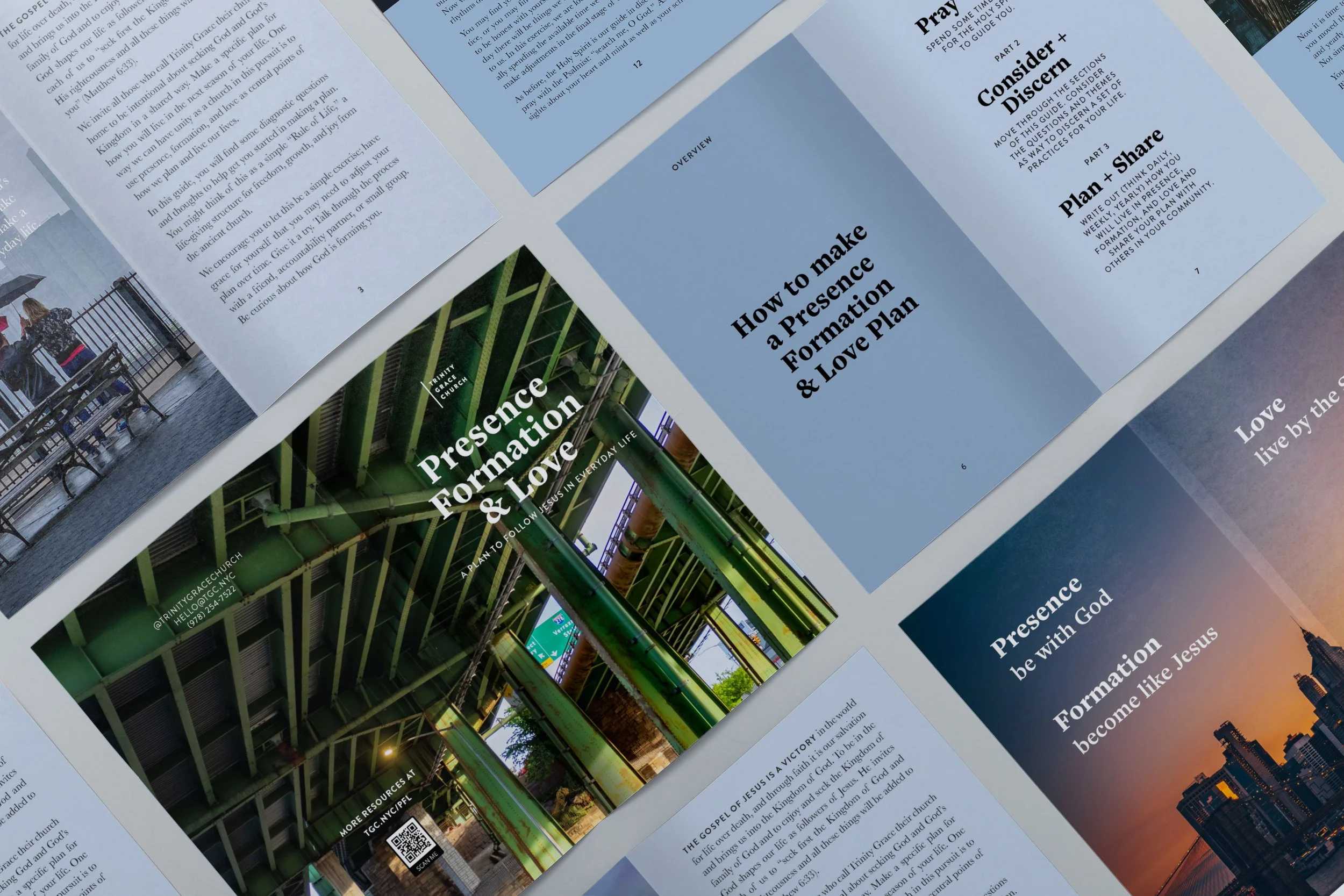
Download this PDF to help you make a plan to follow Jesus in your everyday life, including diagnostic questions to help get you started.
Pickup a print version at our weekly in-person Sunday gatherings.

more Resources
Explore a curated online collection of recommended practices and resources to pursue presence, formation, and love in your life.
Questions about the series or looking for a way to get involved? Contact us.
Love
Teaching Text: Hebrews 4:1-13
Therefore, since the promise of entering his rest still stands, let us be careful that none of you be found to have fallen short of it. For we also have had the good news proclaimed to us, just as they did; but the message they heard was of no value to them, because they did not share the faith of those who obeyed.Now we who have believed enter that rest, just as God has said,
“So I declared on oath in my anger,
‘They shall never enter my rest.’”
And yet his works have been finished since the creation of the world. For somewhere he has spoken about the seventh day in these words: “On the seventh day God rested from all his works.” And again in the passage above he says, “They shall never enter my rest.”
Therefore since it still remains for some to enter that rest, and since those who formerly had the good news proclaimed to them did not go in because of their disobedience, God again set a certain day, calling it “Today.” This he did when a long time later he spoke through David, as in the passage already quoted:
“Today, if you hear his voice,
do not harden your hearts.”
For if Joshua had given them rest, God would not have spoken later about another day. There remains, then, a Sabbath-rest for the people of God; for anyone who enters God’s rest also rests from their works, just as God did from his. Let us, therefore, make every effort to enter that rest, so that no one will perish by following their example of disobedience.
For the word of God is alive and active. Sharper than any double-edged sword,it penetrates even to dividing soul and spirit, joints and marrow; it judges the thoughts and attitudes of the heart. Nothing in all creation is hidden from God’s sight. Everything is uncovered and laid bare before the eyes of him to whom we must give account.
Themes
Consider these themes and ask your group what else they see in the passage:
Hebrews
Enter His Rest
Formation
Thoughts and notes you can use for discussion:
Sermon Summary
EB White on New York City’s restless, sleepless energy —
“There are roughly three New Yorks. There is, first, the New York of the man or woman who was born there, who takes the city for granted and accepts its size, its turbulence as natural and inevitable. Second, there is the New York of the commuter — the city that is devoured by locusts each day and spat out each night. Third, there is New York of the person who was born somewhere else and came to New York in quest of something.”
— E.B. White, Here is New York
It is possible to live with peace and identity intact in such a place?
The book of Hebrews answers with a surprising promise: God’s plan includes a people who enter His rest. That rest is not passivity or boredom, but the very rest of God Himself — offered to us.
The word “rest” in Hebrews 4 carries at least three layers of meaning:
(1) The Sabbath rest God took after creation and invited humanity into from the first day;
(2) The rest of entering the Promised Land under Joshua (Yeshua); and
(3) A future, eternal rest — the unshakeable Kingdom, the new heavens and new earth, the full transformation of creation in which we are called to participate.
In Genesis 1–2, humanity’s very first day is a day of rest — they begin from completion, not striving. In Genesis 15, God makes a covenant with Abraham in a startling way: Abraham falls asleep and God alone passes through the divided animals twice, bearing the cost of both sides of the covenant. This foreshadows the gospel — we cannot keep our end, but God walks the blood path for us. In the Exodus, Israel repeatedly fails to trust and an entire generation dies in the wilderness.
The Promised Land is only a partial picture. Prophets like Jeremiah point forward to a new covenant written on the heart.
Hebrews 4 culminates in a striking image: the Word of God is “sharper than any double-edged sword,” and the Greek word trachēlizō — translated “laid bare” — means to grab an animal by the neck to expose it for sacrifice.
But this same Word has itself been laid bare, hung naked on the cross as the ultimate sacrifice.
Jesus (Yeshua) is the one who finally leads us into rest — not merely by example, but by becoming the Passover lamb. Fifty days later, on Pentecost, the living Word filled his followers with the Holy Spirit — the down-payment of the Kingdom that cannot be shaken.
Invitation: to enter God’s rest is to come through the curtain of Jesus — laying down both sin and self-achievement — and to receive the very life of God in the soul. Being a Christian is not a set of organised beliefs; it is the active experience of God’s love filling and transforming us. We are called not merely to believe, but to be filled with the Spirit — again and again.
Direct Quotes
“For the believers, the final, ultimate goal of this life is eternal life in the world to come or the unshakeable kingdom of God or heavenly home, which is the same as the future city. Most today speak of this final goal as heaven, which it is, but the popular idea of heaven tends to be an immaterial world of spirits and songs rather than the new heavens and new earth coming down to earth. The ultimate goal is about the transformation of all creation, and we are called to participate in the transformation that has already begun.”
— Scot McKnight
“Let anyone who is thirsty come to me and drink. Whoever believes in me, as Scripture has said, rivers of living water will flow from within them.”
— Jesus, John 7:37–38
“Being a Christian is not having a certain set of thoughts organised in your mind about God. It is the active experience of God loving you to death and back.”
— Sermon
Three Questions for Personal Application
Where in your life are you striving to earn rest — through performance, productivity, or achievement — rather than receiving it as a gift from God?
The sermon reminds us that in Genesis, humanity’s very first day was a Sabbath — they began from rest, not from work. Reflect on what it would mean to start from a place of being loved and complete in God, rather than working toward it.
In what areas are you most tempted to “wrench back control” — to operate out of anxiety rather than trust, or worry rather than worship?
Israel repeatedly failed to trust God’s provision in the wilderness. Where are you meeting your deepest needs out of your own resources instead of surrendering to God? What would it look like, in that specific area, to rest in His faithfulness today?
Is your faith primarily a set of beliefs about God, or are you actively experiencing the filling of God’s Spirit in your daily life?
Our closing challenge is that we are called not just to believe, but to be filled — again and again. What might you lay down — shame, or self-sufficiency — to receive more of God’s life? Are there practices or postures that would help you remain open to the Spirit’s active presence?
“There remains, then, a Sabbath-rest for the people of God.” — Hebrews 4:9