About This Guide
The online groups guide is designed as a teaching series companion to foster discussion, study, and prayer, especially in a group setting.
Join a weekly group for a meaningful way to connect to our community.
pdf download
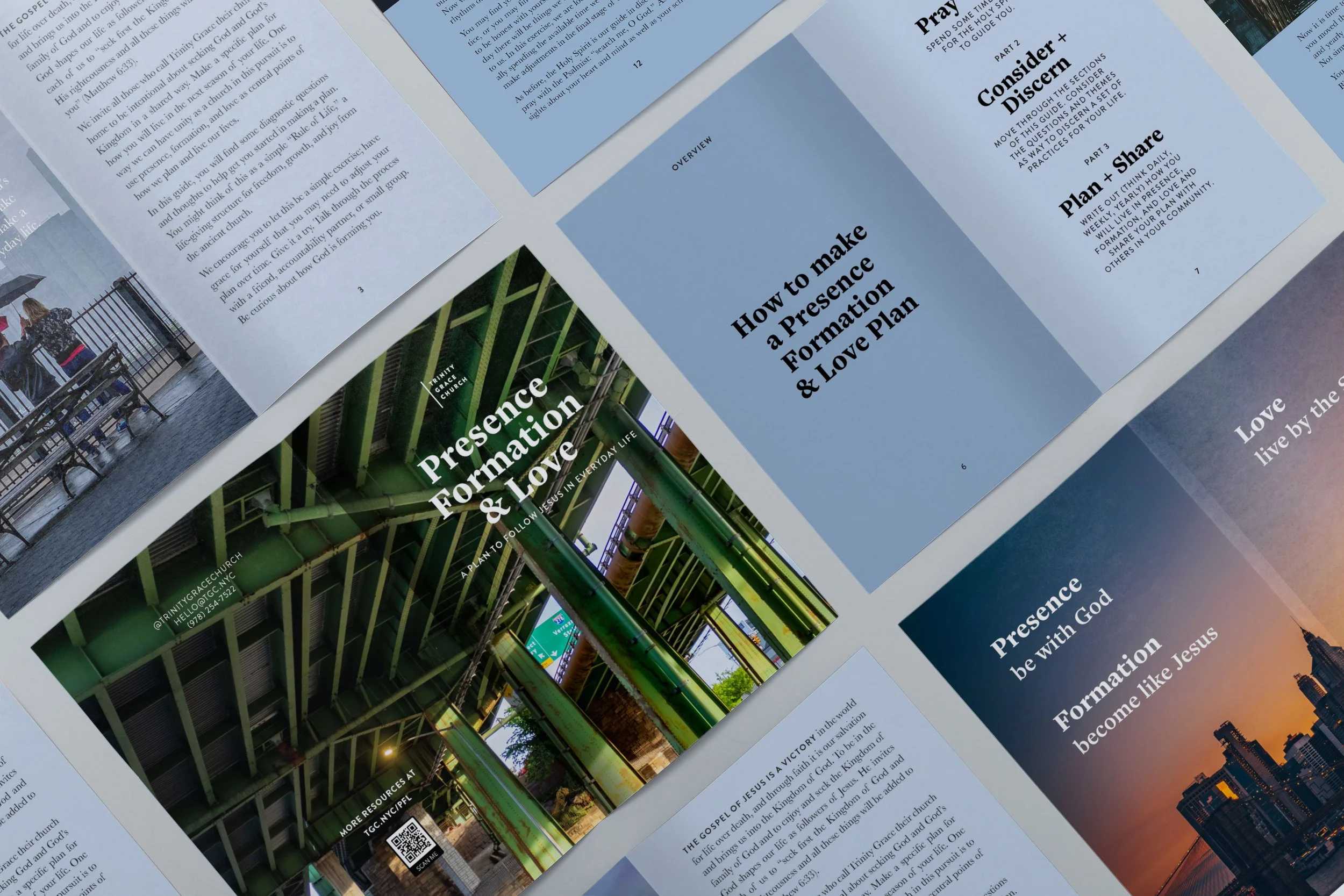
Download this PDF to help you make a plan to follow Jesus in your everyday life, including diagnostic questions to help get you started.
Pickup a print version at our weekly in-person Sunday gatherings.

more Resources
Explore a curated online collection of recommended practices and resources to pursue presence, formation, and love in your life.
Questions about the series or looking for a way to get involved? Contact us.
Love
Teaching Text: Hebrews 9:1-28
Now the first covenant had regulations for worship and also an earthly sanctuary. A tabernacle was set up. In its first room were the lampstand and the table with its consecrated bread; this was called the Holy Place. Behind the second curtain was a room called the Most Holy Place, which had the golden altar of incense and the gold-covered ark of the covenant. This ark contained the gold jar of manna, Aaron’s staff that had budded, and the stone tablets of the covenant. Above the ark were the cherubim of the Glory, overshadowing the atonement cover. But we cannot discuss these things in detail now.
When everything had been arranged like this, the priests entered regularly into the outer room to carry on their ministry. But only the high priest entered the inner room, and that only once a year, and never without blood, which he offered for himself and for the sins the people had committed in ignorance.The Holy Spirit was showing by this that the way into the Most Holy Place had not yet been disclosed as long as the first tabernacle was still functioning. This is an illustration for the present time, indicating that the gifts and sacrifices being offered were not able to clear the conscience of the worshiper. They are only a matter of food and drink and various ceremonial washings—external regulations applying until the time of the new order.
But when Christ came as high priest of the good things that are now already here, he went through the greater and more perfect tabernacle that is not made with human hands, that is to say, is not a part of this creation. He did not enter by means of the blood of goats and calves; but he entered the Most Holy Place once for all by his own blood, thus obtaining eternal redemption. The blood of goats and bulls and the ashes of a heifer sprinkled on those who are ceremonially unclean sanctify them so that they are outwardly clean. How much more, then, will the blood of Christ, who through the eternal Spiritoffered himself unblemished to God, cleanse our consciences from acts that lead to death, so that we may serve the living God!
For this reason Christ is the mediator of a new covenant, that those who are called may receive the promised eternal inheritance—now that he has died as a ransom to set them free from the sins committed under the first covenant.
In the case of a will, it is necessary to prove the death of the one who made it,because a will is in force only when somebody has died; it never takes effect while the one who made it is living. This is why even the first covenant was not put into effect without blood. When Moses had proclaimed every command of the law to all the people, he took the blood of calves, together with water, scarlet wool and branches of hyssop, and sprinkled the scroll and all the people. He said, “This is the blood of the covenant, which God has commanded you to keep.” In the same way, he sprinkled with the blood both the tabernacle and everything used in its ceremonies. In fact, the law requires that nearly everything be cleansed with blood, and without the shedding of blood there is no forgiveness.
It was necessary, then, for the copies of the heavenly things to be purified with these sacrifices, but the heavenly things themselves with better sacrifices than these. For Christ did not enter a sanctuary made with human hands that was only a copy of the true one; he entered heaven itself, now to appear for us in God’s presence. Nor did he enter heaven to offer himself again and again, the way the high priest enters the Most Holy Place every year with blood that is not his own. Otherwise Christ would have had to suffer many times since the creation of the world. But he has appeared once for all at the culmination of the ages to do away with sin by the sacrifice of himself. Just as people are destined to die once, and after that to face judgment, so Christ was sacrificed once to take away the sins of many; and he will appear a second time, not to bear sin, but to bring salvation to those who are waiting for him.
Themes
Consider these themes and ask your group what else they see in the passage:
Hebrews: A new and Living Way
Eternal Redemption Through the Blood of Christ
Formation
Thoughts and notes you can use for discussion:
Sermon Summary
This passage gets to the heart of things. The heart of the letter. The heart of each person. The heart of the universe. The heart of heaven. It’s also mysterious — blood, hidden inner rooms, sacrifices, visions of heaven and an age to come.
If A24 made a trailer for this passage it would be very creepy. I might have to look away. I don’t do well with scary movies — and A24 can make going to the furniture store scary.
It can feel like eavesdropping on a high-level lecture to first-century Jewish believers. The imagery is unfamiliar. It may feel like Willy Wonka hid the Golden Ticket inside unseasoned Brussels sprouts. But it is so worth plunging down into. Because behind all the talk of covenants and tabernacle rooms and old priesthoods, this passage gives us an honest vision of God and a true picture of ourselves.
The mystery at the heart of the universe: there is a type of life in God that cannot be approached casually. God is Holy, Holy, Holy — set apart, other. A concentration of life and light and power so intense you cannot stand in the full revelation of God and survive.
So in Scripture God keeps holding back. The angel of the Lord. The burning bush. The back shoulder of God while Moses hides in the cleft of the rock. Isaiah sees a vision and is undone. Elijah gets a whisper and covers his face. The more of God someone encounters, the less they can handle it.
God dwells in unapproachable light. And the late-modern assumption that science has neatly answered everything is a presumptuous lie — no real view of the world makes no room for weirdness. We are spiritual creatures on a planet uniquely suited for life in an ever-expanding universe.
Here is the tension: God is love. God creates from overflow, not lack — makes people for relationship and joy in His presence. But after Genesis 3 we can no longer walk with God in the cool of the evening. The problem is not with God. It’s with us. We grasped for control, tried to be our own gods, and unleashed the thing that rips through the human story.
Separation from God is separation from Life. That is death. It’s like being so sick we have to be quarantined from someone so well their life would overwhelm us. But God is determined to set the world right.
The tabernacle was God’s way of teaching a rescued community to live with His presence at the center — how to approach Him, how to deal with the death ripping through their story. We are not starting from scratch. We are not the first to seek God or wrestle with these struggles. The tabernacle held a record of what had come before. But for all its good, it was limited — never meant to be the full revelation.
One key access point to this mystery is our conscience — the powerful internal recognition that things are not right. Jiminy Cricket. Kafka’s Josef K, arrested but never told why. Lady Macbeth, unable to wash out the spot. Raskolnikov’s guilty torment. The old tabernacle could not cleanse the conscience.
So never mind approaching a holy God — we struggle to live with ourselves. And it’s worse than sensing something wrong “out there.” We contribute to the brokenness. We do our own damage, and our conscience testifies against us. We lack peace. We carry guilt over what we’ve done and shame over who we are. Most of us know both.
Here is what Hebrews is telling us, even if the form isn’t immediately attractive: what Christ has come to do is make it so we can live with God. Covered in mercy and redemption, able to stand one day before the full revelation of Yahweh, drawn near in the Holiest place. And Christ is cleansing our conscience — bringing us to peace in ourselves, making it well with my soul.
For Christ did not enter a sanctuary made with human hands that was only a copy of the true one; He entered heaven itself, now to appear for us in God’s presence.
— Hebrews 9:24
What Christ is doing is making everything right at every level.
What the former tabernacle could do was teach three things:
Approach God with care — not because God is bad, but because God is so good, such a concentration of life.
Sin wrecks your life with God and with each other — there is an immense cost to sin.
God is already at work in revelation and in healing the world — the jar of manna, Aaron’s staff that budded, the stone tablets.
The Holy of Holies is the innermost place — where we cannot go. And Christ is making us ready for it. A deep clue to that reality is our own conscience: the most inner, set-apart place of the human person. Christ is making peace for both.
There is no forgiveness without someone absorbing the cost of the wrong done. The final outworking of sin is death — disconnection from Life. But the Deeper Magic is this: if an innocent one absorbs the cost and gives their life out of love, it can count on behalf of the condemned. It can make us right with God, with death, and even with the accusing voice of our own conscience.
If the Son has set you free, you are free indeed.
So — Jesus’ blood has accomplished an eternal redemption. There are stages: now we have Christ’s forgiveness and filling; one day, the fullness of God’s revealed presence in the age to come. The new covenant is grace realized. The ministry of Jesus goes on — intercession.
Where is your conscience troubled? Where is your confidence located? Come boldly before the throne of grace in your time of need. We are going to be brought into the Holy Place. That is where God is. That is our hope.
Direct Quotes
We are not easeful human beings who occasionally get restless, serene persons who once in a while are obsessed by desire. The reverse is true. We are driven persons, forever obsessed, congenitally dis-eased, living lives, as Thoreau once suggested, of quiet desperation, only occasionally experiencing peace.
— Ronald Rolheiser
We are more deeply flawed than we could ever dare imagine. But we are more deeply loved than we could ever dare hope.
— Tim Keller
What C.S. Lewis in Narnia called the Deeper Magic: if an innocent one absorbs the cost, gives their own life out of love, that can count on behalf of the separated and condemned.
— on C.S. Lewis
Three Questions for Personal Application
Where is your conscience troubled right now?
Name the place that lacks peace — the guilt over what you’ve done, the shame over who you are. Bring it honestly to God rather than burying it. The conscience is the inner room Christ has come to cleanse.
Where is your confidence located?
Notice what you reach for to feel right with the world — performance, approval, control. Ask whether your peace rests on your own efforts or on what Christ has already accomplished once for all.
Are you drawing near, or holding back?
God dwells in unapproachable light, yet invites you to come boldly to the throne of grace. Consider where fear or self-condemnation keeps you at a distance, and what it would mean to approach as one already set free.
“But He has appeared once for all at the culmination of the ages to do away with sin by the sacrifice of Himself.”
— Hebrews 9:26