About This Guide
The online groups guide is designed as a teaching series companion to foster discussion, study, and prayer, especially in a group setting.
Join a weekly group for a meaningful way to connect to our community.
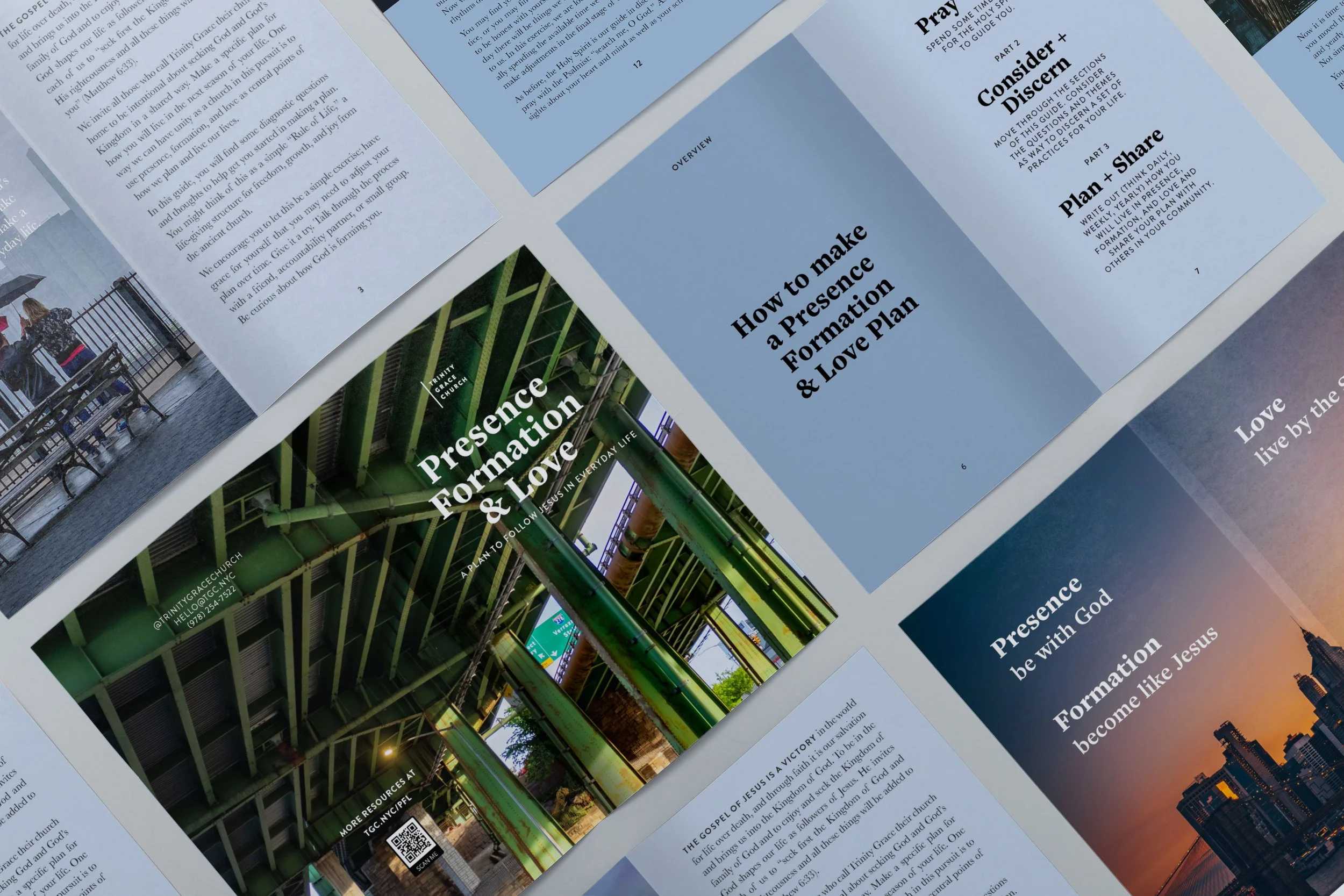
pdf download
Download this PDF to help you make a plan to follow Jesus in your everyday life, including diagnostic questions to help get you started.
Pickup a print version at our weekly in-person Sunday gatherings.

more Resources
Explore a curated online collection of recommended practices and resources to pursue presence, formation, and love in your life.
Questions about the series or looking for a way to get involved? Contact us.
Love
Teaching Text: Hebrews 6:13-7:10
When God made his promise to Abraham, since there was no one greater for him to swear by, he swore by himself, saying, “I will surely bless you and give you many descendants.” And so after waiting patiently, Abraham received what was promised.
People swear by someone greater than themselves, and the oath confirms what is said and puts an end to all argument. Because God wanted to make the unchanging nature of his purpose very clear to the heirs of what was promised,he confirmed it with an oath. God did this so that, by two unchangeable things in which it is impossible for God to lie, we who have fled to take hold of the hope set before us may be greatly encouraged. We have this hope as an anchor for the soul, firm and secure. It enters the inner sanctuary behind the curtain, where our forerunner, Jesus, has entered on our behalf. He has become a high priest forever, in the order of Melchizedek.
This Melchizedek was king of Salem and priest of God Most High. He met Abraham returning from the defeat of the kings and blessed him, and Abraham gave him a tenth of everything. First, the name Melchizedek means “king of righteousness”; then also, “king of Salem” means “king of peace.” Without father or mother, without genealogy, without beginning of days or end of life, resembling the Son of God, he remains a priest forever.
Just think how great he was: Even the patriarch Abraham gave him a tenth of the plunder! Now the law requires the descendants of Levi who become priests to collect a tenth from the people—that is, from their fellow Israelites—even though they also are descended from Abraham. This man, however, did not trace his descent from Levi, yet he collected a tenth from Abraham and blessed him who had the promises. And without doubt the lesser is blessed by the greater. In the one case, the tenth is collected by people who die; but in the other case, by him who is declared to be living. One might even say that Levi, who collects the tenth, paid the tenth through Abraham, because when Melchizedek met Abraham, Levi was still in the body of his ancestor.
Themes
Consider these themes and ask your group what else they see in the passage:
Hebrews: A new and Living Way
Confidence in God's Promises
Formation
Thoughts and notes you can use for discussion:
Sermon Summary
It started over breakfast. Sitting at an outside table before the work day, a friend with little church experience asked the question flat out:
“Why did Jesus die on the cross?”
The moment was almost comic — someone had been laughing at an absurd ad, a ripped, eight-pack-abs Jesus on a body pillow. But behind the joke was a real question she’d carried a long time without a satisfying answer. What does it mean that Jesus died for our sins? Why doesn’t God just forgive us? And how strange is it to wear a method of execution as jewelry?
The answer runs through the whole story: God keeps His promises — even when the cost of keeping them is death — and He takes that death onto Himself.
The Scriptures open with overflow. Teeming, bountiful life from a God who shares. The first lie introduced scarcity — that maybe God was holding out, keeping something good from us. And whatever sin is, it is movement away from God, His word, His presence, His promises. Move away from the source of life and what fills the gap is death. Death as an ending. Death as separation. It entered the abundant places and has stalked the human experience ever since.
The old sacrifices — lambs, doves, bulls, grain — showed Israel the tangible cost. When you lie, steal, harm, envy, objectify, forget the poor, refuse to sabbath — something dies. Trust, peace, goodwill, a sense of abundance. When forgiveness is shared, someone is absorbing the cost. On the cross, Jesus absorbed the cost of death for all of us — and opened the way back to abundant life.
After Eden, Genesis records two great devastations — the ravaging of death in the flood, and the tragedy of trying to be godlike without God at Babel. Then Genesis 12 turns everything:
God begins a deliberate work of repair, and starts by inviting one person to trust him.
He goes to a 75-year-old man, asks him to leave everything he knows, and to go.
He promises to bless him, make him a nation, and through him bless the whole world.
The Kingdom of God moves along relational lines. And it moves through promises — promises made and promises believed. If you want an access point to the Kingdom this morning, take a promise from God and believe it. Live like it’s true, and you’ll discover that it is.
In Genesis 15 God confirms the promise with an oath. By covenant custom, both parties walk the blood path between split animals: if I break my part, may this happen to me. But Abraham falls asleep, and God passes through twice — as if to say, I will keep my end, and when you fail, I will keep yours too. By two unchangeable things — God’s promise and God’s oath — and because God cannot lie, this hope is secure.
Then God shows Abraham what it will cost. In the covenant of the animals, and later in the test with Isaac, God discloses the price of repair. Abraham sleeps on covenant night; Abraham is stopped before offering Isaac. God says: I will pay the cost myself. I will take this death — to give you life.
And so God becomes for us both King and Priest. The one who makes the promise and the one who pays to keep it. The one who declares the way and the one who opens it. There are no priest-kings in the Hebrew Scriptures — except one strange blip. Abraham meets Melchizedek, King of Salem, whose name means king of righteousness, from the place of peace. The story gives him no beginning and no end. A picture of what was coming: a Priest and King of righteousness and peace, with no beginning and no end, who can be trusted forever.
You can be confident in God’s promises. They are more true than your circumstances, your moods, your worst mistake or greatest failure. God’s character and promises are the foundation of reality. Sometimes the wait is longer than we’d like — Abraham was 75 when called, 100 when Isaac came. (The Knicks waited 53 years; it’s not always our chosen timeline.) But God keeps his promises.
So here is what you can count on:
The hope of Christ is an anchor for the soul. An anchor goes down deep, where we cannot reach, and fastens to the rock. Christ has gone where we could not go, and our connection to Him holds firm — in the gentle tides of doubt and the sway of sin, and in tragedy, chaos, and grief.
This anchor is also a Priest who has gone into the inner sanctuary. Christ’s death made the way; His life holds our place. At His death the foot-thick veil tore from top to bottom — the way is opened. And at Pentecost, the presence of God comes to fill the temple of our lives by the Holy Spirit.
Mercy reigns. Jesus is King of righteousness and peace, both holy and the one who makes us holy. Mercy is on the throne of the universe. The highest authority anywhere is offering mercy.
If God forgives me, then I can forgive me. There is no higher standard than God. So when shame comes knocking, when failures scream, when sorrow threatens to crush — speak back that the highest authority loves me, accepts me, welcomes me, and has declared it is finished. My life is His; His life is mine.
And there is a generosity of grace that keeps going forever. Abraham’s joy at meeting the Priest-King overflows into a tenth of all he has — just a glimpse of the way of the Kingdom. What is sown in grace keeps going. When we give ourselves away, we join with God, and the share is unending. No one can take from you what God has given.
The Kingdom moves along relationships. It is revealed when someone hears the promise of God and takes it as true. Why did Jesus die for us? Because the Love that is God knows what it will take to repair the world — and starting with us, God says: I will do this. I will take what is yours, and give you what is mine. And the share you have in my life will never end.
It is an anchor for your soul. It is in the Holy of Holies. Your name is spoken there. Your future is with God.
Come and believe the promise.
Direct Quotes
I like to imagine Abraham, looking every bit the madman, staring out into the frightening void of the dark desert. Feeling a pull, a powerful tow toward a nameless, unseen God. Behind him, all the might of the city, the walls of the grain storehouses. From the towering pyramid-shaped temple he can hear the drums, screams, and pagan chanting. In his gut, the doubt, the conflicting emotions, the fear that everything he has believed until now is wrong. The city represented safety, comfort, the known. In front of him, the desert representing death, darkness, mystery, and the unknown. Then the resolution, the determination, the trust, followed by the first step, away from the city, away from Ur. The first step of faith into the unknown, into the arms of God.
— Mark Sayers
I will take what is yours, and I will give you what is mine. And the share you have in my life will never end.
Three Questions for Personal Application
Where am I being invited to take a promise from God and simply believe it — to live as if it’s true?
The Kingdom opens when someone hears a promise and trusts it. Name the one promise you’ve been holding at arm’s length, and ask what it would look like to stake your week on it.
What cost am I trying to absorb on my own that Christ has already absorbed for me?
We so often try to meet the deep needs of our soul out of our own resources. Where are you carrying shame, failure, or striving that the cross has already settled? Let mercy, not your own effort, be the foundation you stand on.
If mercy is truly on the throne, where do I need to extend that same generosity — to others, and to myself?
There is no higher standard than the God who forgives you. Consider one relationship — possibly your relationship with yourself — where you’ve withheld the grace you’ve already received, and let it flow freely.
“We have this hope as an anchor for the soul, firm and secure. It enters the inner sanctuary behind the curtain, where our forerunner, Jesus, has entered on our behalf.”
— Hebrews 6:19–20