About This Guide
The online groups guide is designed as a teaching series companion to foster discussion, study, and prayer, especially in a group setting.
Join a weekly group for a meaningful way to connect to our community.
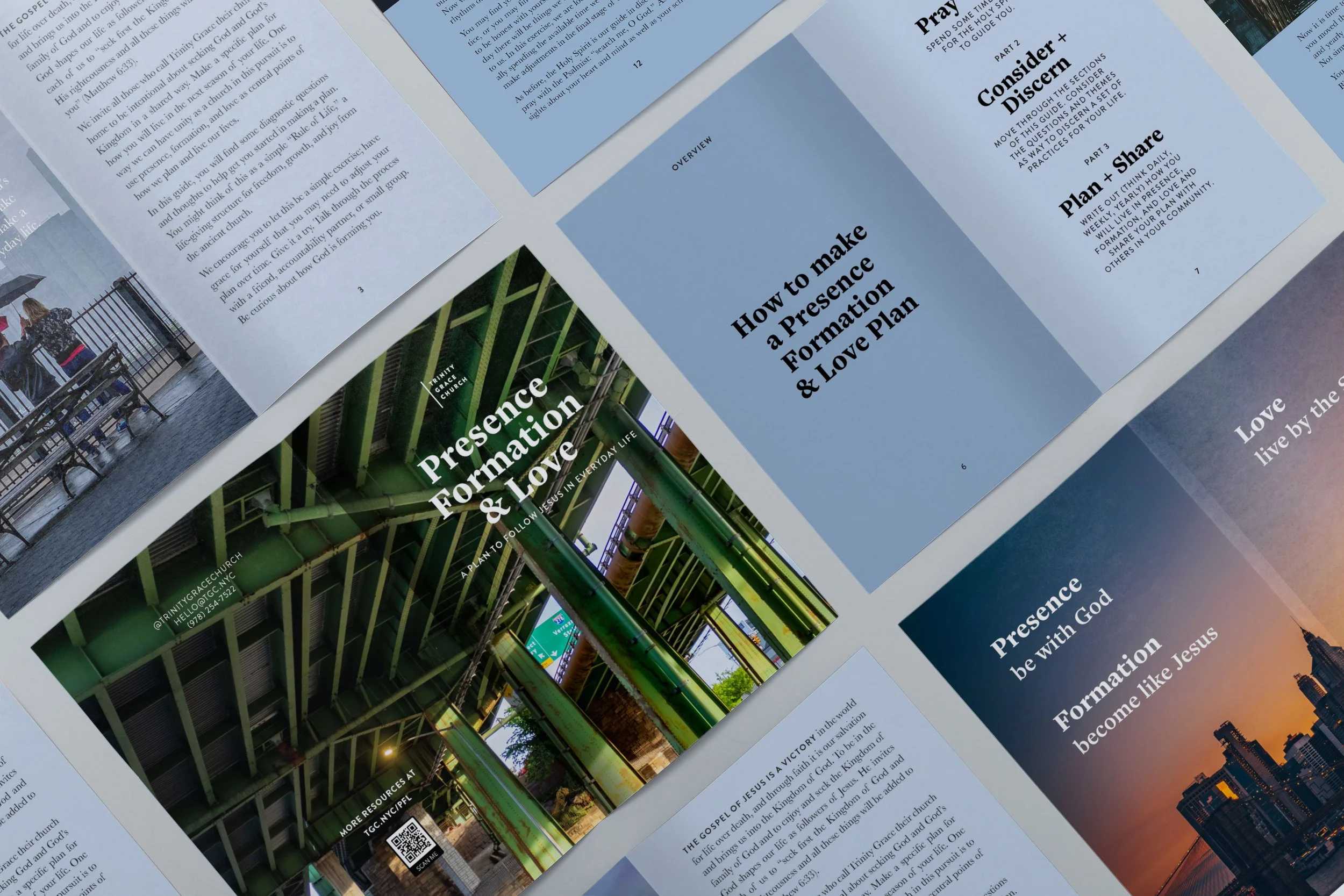
pdf download
Download this PDF to help you make a plan to follow Jesus in your everyday life, including diagnostic questions to help get you started.
Pickup a print version at our weekly in-person Sunday gatherings.

more Resources
Explore a curated online collection of recommended practices and resources to pursue presence, formation, and love in your life.
Questions about the series or looking for a way to get involved? Contact us.
Love
Teaching Text: Hebrews 10: 19–26
Therefore, brothers and sisters, since we have confidence to enter the Most Holy Place by the blood of Jesus, by a new and living way opened for us through the curtain, that is, his body, and since we have a great priest over the house of God, let us draw near to God with a sincere heart and with the full assurance that faith brings, having our hearts sprinkled to cleanse us from a guilty conscience and having our bodies washed with pure water. Let us hold unswervingly to the hope we profess, for he who promised is faithful. And let us consider how we may spur one another on toward love and good deeds, not giving up meeting together, as some are in the habit of doing, but encouraging one another—and all the more as you see the Day approaching.
If we deliberately keep on sinning after we have received the knowledge of the truth, no sacrifice for sins is left,
Themes
Consider these themes and ask your group what else they see in the passage:
Hebrews: A new and Living Way
Holding the Promise
Formation
Thoughts and notes you can use for discussion:
Sermon Summary
“A few months ago I was talking to my friend Zaki, and he told me that in Africa they use a lot of spices — pepper, onions, garlic, ginger. ‘It has spiciness,’ he said. ‘Not like American food.’”
She’d made a beef dish with a peanut butter sauce — Domodo, a West African stew — and protested when Zaki said it wasn’t really African food. It took her a year of trial and error, an unhelpful-but-fascinating YouTube video from a family in Guinea-Bissau, before she finally tried real jollof from a takeout container at Penn Station. And even then, she didn’t get it. She knew all the words — spicy, garlic, onion, pepper — but “spicy” wasn’t a taste. It was a full-mouth experience, something you had to feel, not just name.
That’s the gospel too. We have the ingredient list — sin, repentance, righteousness, grace, salvation — and it’s easy to memorize the words without ever tasting the thing itself. We need to experience the living Word, not just describe it.
Jesus is better — better than the prophets, better than the angels, better than Moses, better than Joshua. A better High Priest, offering a better sacrifice, introducing a better covenant. Because of all this, we can walk boldly into the Holy Place.
That boldness used to be unthinkable. Herod’s temple was massive and lavish, one of the wonders of the ancient world — and almost entirely closed off. Priests were barred for scabs, blindness, a crippled hand. Only the high priest, once a year, could pass the veil: four inches thick, sixty feet tall, thirty feet wide, dividing heaven from earth. Women could go only as far as the women’s court. Gentiles stopped at the outer court — Acts 21 records a near-riot and a death sentence for a Gentile who went further.
Then Jesus said, “It is finished,” and the veil tore from top to bottom. This isn’t a formula to perform — draw near, then hold fast, then stir up. It’s a description of what’s already true.
Picture a Norwegian soccer player from Svalbard, above the Arctic Circle, living through two months of polar night — then flown to Texas for the World Cup. The sun doesn’t depend on how early he wakes or how he feels that morning. He’s simply been moved into the light. You were once darkness — but now you are light in the Lord.
That’s not theory. During Covid, with the cafe on the edge of closing, she and her community started giving away grilled cheese sandwiches and vegan chili, pushing tables together, taking whatever neighbors could bring. She stood in the middle of it — not because she had resources of her own, but as an intercessor between pinto beans and food insecurity. God didn’t take the suffering away. He showed her he was there in the middle of it.
What started with a handful of families became fifty, sent groceries twice a week through June. Six years later it’s grown into Good Neighbors: sandwiches by the hundreds, a women’s group, a running group for new immigrants, teenagers giving up their beds in solidarity with unhoused youth.
The veil is torn. The way is open. We who were once far off have been brought near.
Communion table. Then sandwiches for the neighborhood.
Direct Quotes
“Therefore, brethren, having boldness to enter the Holiest by the blood of Jesus… let us draw near with a true heart in full assurance of faith… Let us hold fast the confession of our hope without wavering, for He who promised is faithful. And let us consider one another in order to stir up love and good works, not forsaking the assembling of ourselves together.”
— Hebrews 10:19–25
“Because of his humanity the death of Jesus is truly a human one, but because of his divinity the cross is truly the death of the immortal God in human flesh — and therefore takes on cosmic redemptive significance as the defeat of death and sin.”
— Frederick Bauerschmidt
“God is love and the love that is God is a crucified love. We love because he first loved us. He poured himself out. He conquered sin and death. He translated us out of darkness and into his marvelous light.”
— from the message
“My children are older. They understand being hungry.”
— a neighbor, quoted in the message
Three Questions for Personal Application
Do yoDo you relate to God through a formula, or through a relationship you already have full access to? Notice if “drawing near” feels like a checklist — quiet time, then obedience, then service — rather than something already true of you in Christ. Ask what it would mean to rest in access already given rather than performance still owed.
Where in your life do you still feel like you’re standing in the outer court — held back by old shame or a barrier Jesus already tore down? Name the specific thing you think disqualifies you. Bring it honestly to God and ask him to show you what’s actually true now that the veil is gone.
Where is God inviting you to taste and see, rather than just know the right words about him? Think of one place this week — in prayer, in service, in a hard relationship — where you could move from talking about faith to actually living it out with someone else. Ask him what it would look like to draw near there.
“Let us hold fast the confession of our hope without wavering, for He who promised is faithful.”
— Hebrews 10:23